
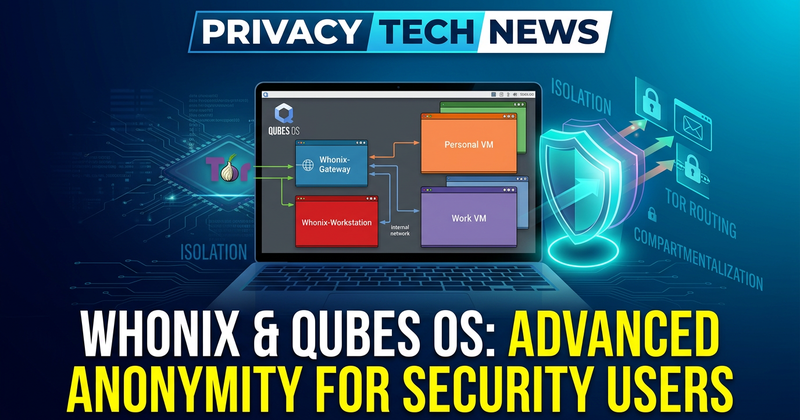
Whonix and Qubes OS represent the upper tier of available anonymity and security tools for desktop computing. While Tails is the recommended option for many users due to its simplicity and amnesia properties, users with complex requirements or ongoing workflows that benefit from persistence often turn to Whonix, Qubes, or a combination of both.
Whonix: Isolation Through Virtualisation
Whonix is a desktop operating system designed for advanced security and privacy. It consists of two virtual machines: the Whonix-Gateway and the Whonix-Workstation. All internet traffic from the Workstation is routed through the Gateway, which in turn connects only through Tor. This architecture means that even if malware compromises the Workstation VM, it cannot directly access the network outside of Tor. The IP address and network identity remain protected at the hypervisor level, not merely within the application layer.
Qubes OS: Security Through Compartmentalisation
Qubes OS is built around the principle of security through compartmentalisation. Rather than running all applications in a single operating system environment, Qubes provides separate virtual machines (called "qubes" or "domains") for different activities. A user might have separate qubes for banking, general browsing, personal email, and sensitive work, ensuring that a compromise of one domain cannot spread to others. Each qube runs in a lightweight Xen virtualisation environment and can be configured with different security levels and network access policies.
Combining Qubes and Whonix
Qubes-Whonix is a configuration that runs Whonix inside Qubes OS, combining the network-level anonymity of Whonix with the compartmentalisation of Qubes. In this setup, the Whonix-Gateway runs in one Qubes domain, and the Whonix-Workstation runs in another. All traffic from the Workstation domain is routed through the Gateway domain and out through Tor. Critically, the two VMs cannot communicate directly, and neither can communicate with other Qubes domains without explicit configuration.
Practical Considerations
Both Whonix and Qubes OS have higher hardware requirements than conventional operating systems. Qubes in particular requires a processor with hardware virtualisation extensions and benefits significantly from 16GB or more of RAM. The setup process is more involved than installing Tails, and troubleshooting requires greater technical familiarity. However, for users with ongoing needs for persistent, compartmentalised, and anonymous computing, the security benefits justify the additional complexity.
Qubes-Whonix represents the most robust combination of anonymity and compartmentalisation available on desktop hardware, recommended by security researchers and digital rights organisations for users operating in high-risk environments.