
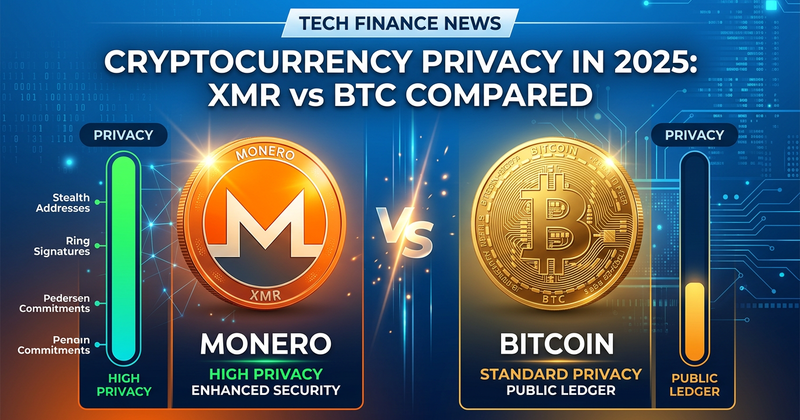
The question of which cryptocurrency offers better privacy has moved from theoretical debate to operational necessity for users of privacy-focused networks and markets. In 2025, the comparison between Monero (XMR) and Bitcoin (BTC) is sharper than ever, with chain analysis capabilities having advanced considerably over the past five years.
Bitcoin's Privacy Model
Bitcoin's blockchain is fully public. Every transaction, address, and balance is visible to anyone who examines the chain. Bitcoin achieves pseudonymity rather than anonymity: addresses are not directly linked to real-world identities in the protocol itself, but external data points — exchange KYC records, IP addresses recorded at the time of transaction broadcast, on-chain behaviour patterns — can be used to deanonymise users over time. Chain analysis firms have demonstrated the ability to trace Bitcoin transactions through multiple hops and link them to exchange accounts, sometimes years after the fact.
Privacy Techniques for Bitcoin
Several techniques exist to improve Bitcoin privacy. CoinJoin allows multiple users to combine their transactions into a single transaction with multiple inputs and outputs, obscuring the link between specific inputs and outputs. Implementations like Whirlpool and WabiSabi (used in Wasabi Wallet) automate this process. Using a new address for each transaction, running a personal full node, and broadcasting transactions over Tor all reduce the information available to observers. However, all of these measures require active effort and provide probabilistic rather than guaranteed privacy.
Monero's Privacy Model
Monero provides privacy by default. Ring signatures, stealth addresses, and RingCT are mandatory for all transactions — there is no way to send a non-private Monero transaction. Ring signatures mix the sender's transaction with those of other recent participants, making it statistically impossible to determine with certainty which input funded a given output. Stealth addresses ensure that each received payment appears at a unique one-time address. RingCT conceals transaction amounts entirely. The result is a blockchain that reveals only that transactions occurred, not who sent them, who received them, or how much was transferred.
The 2025 Landscape
In 2025, the gap between Bitcoin and Monero privacy has widened. Chain analysis firms claim increasingly high confidence levels in Bitcoin transaction tracing. No credible blockchain analysis firm has demonstrated the ability to reliably deanonymise on-chain Monero transactions when users follow basic OPSEC practices. For users who require genuine financial privacy, Monero remains the technically superior choice by a significant margin.
Both currencies have a role, but their privacy properties are fundamentally different. Understanding this difference is essential for anyone managing financial risk in privacy-sensitive contexts.